Of course A Is A, by Mike Gold
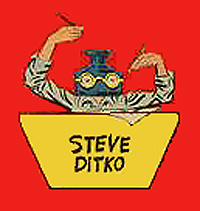 I finally got around to watching Jonathan Ross’s excellent BBC-TV documentary In Search of Steve Ditko and I’ve gotta tell you, this week’s Wazoo is going to be about one-third disclosures.
Disclosure #1 – I know Jonathan Ross. I gave him his first tour of DC Comics. At the same time, Karen Berger was giving Neil Gaiman a tour. Jonathan is a major teevee star out in Britain but was largely unknown in the States at the time. A long, long time comics fan (he owned a London comics store with Rolling Stone correspondent and seminal letterhack Paul Gambaccini), I think Jonathan was really into the anonymity of the tour… until we turned the corner and smacked into Gaiman. Being British and familiar with Ross’s work, Neil turned into a babbling fanboy. Being a comics fan, Jonathan was already a babbling fanboy. The two got along famously, while Karen and I were having a nice chat on the side. This connection actually becomes relevant anon.
Disclosure #2 – I know Steve Ditko. I love his stuff; all of it. We worked together on several comics projects, one of my personal fanboy highlights was standing in his studio in the then-lower rent portion of Times Square, and we’ve had lunch and dinner together on several occasions, usually with my pal and his frequent collaborator Jack C. Harris. We talked politics (go figure) and philosophy. In private, Steve was always free about his experiences at Marvel. This, too, actually becomes relevant anon.
One of the more interesting experiences I enjoyed was introducing Steve to Ross Andru. Both came into the business at roughly the same time and, coincidentally, both had drawn Spider-Man… although, of course, only one had co-created the character. Ross was as quiet as he was fascinating. He was well-versed on the Illuminati conspiracy, which was a favored topic of ours. I digress.
We were at DC’s old 666 Fifth Avenue offices (talk about conspiracies) and we were in a public space. Ross wanted to know if he could ask Steve a question. I could see Steve bracing himself, but he agreed. Ross made a Strange gesture. “Why do you draw hands like that?” Steve laughed and posed his hand exactly true to form. Exactly. I know you think you can do it; you can’t. Only Steve Ditko can.
“Because it looks more interesting that way,” Steve said. “Oh,” Ross replied. “I always wondered.”
I had heard Steve’s laugh before; he has a wonderful sense of humor. Surprising, if you’re only familiar with his philosophical stuff. That aspect of Ditko’s was just about the only thing missing from Jonathan’s documentary.
The show ends with Jonathan and Neil Gaiman teaming up in front of what was reported to be the building that housed Steve’s studio. True to form, Steve wouldn’t submit to an interview, but he did allow the two into his office for a long chat, wherein Steve told them what he told many others, including this reporter. What Ross Andru wouldn’t ask.
Jonathan and Neil came downstairs to the cameras, gushing as I did when I first left Steve’s studio. But they would not tell the Marvel story. Steve trusted them, and they would not betray that trust. “The first rule of Fight Club…” Jonathan cited.
Well, there’s lots of us in that Fight Club, and we have not betrayed that trust. If the Ditko / Andru conversation hadn’t happened in public, I would not have even reported that story. Steve played too important a role in our development as comics enthusiasts for us to rat him out. That’s the truest testimonial to Steve Ditko as an artist, and Jonathan did the right thing.
After all, right is right. A is A.
Mike Gold is editor-in-chief of ComicMix.